
Are you looking to reduce your energy bills?
Hoping to improve your home’s energy rating?
Want to become less reliant on the grid?
Already have —or thinking about installing an EV charger?
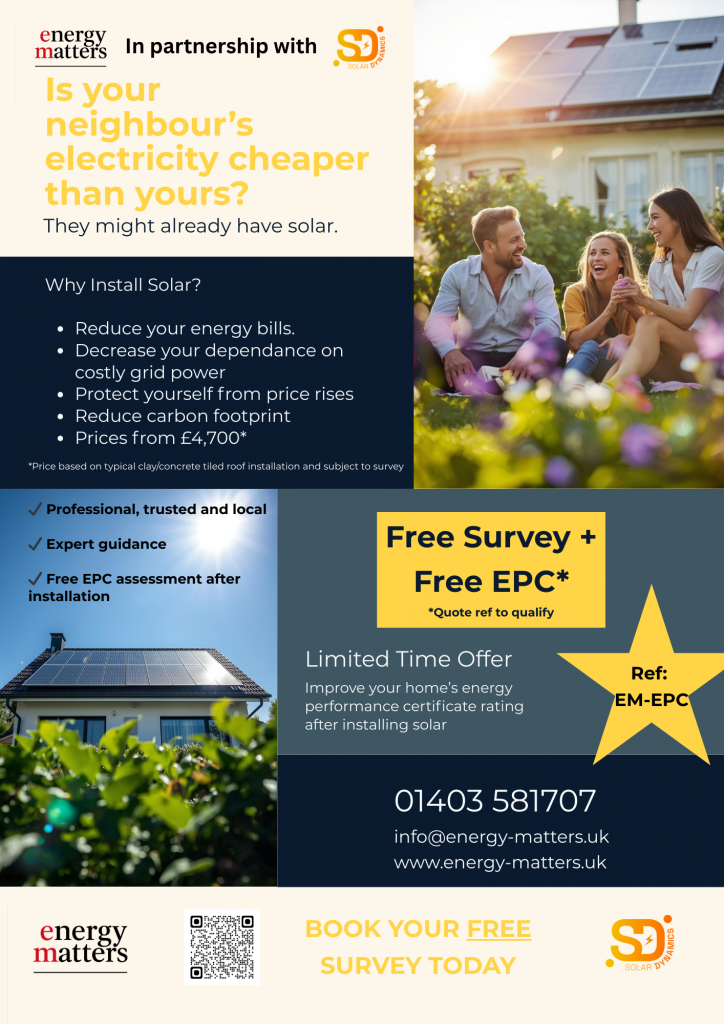
If you answered yes to any of the questions above, get in touch today for a free, no‑obligation solar survey. And once your installation is complete, you can take advantage of our free EPC offer* and see exactly how much your home’s energy performance score has improved.
Energy Matters has partnered with one of the South’s leading solar specialists, Solar Dynamics. They are a trusted renewable energy company providing the design, supply, and installation of cutting‑edge solar PV systems, battery storage solutions, and EV charging technology for both residential and commercial clients.
Their mission is to deliver sustainable energy solutions that lower costs while supporting a greener future. They’re recognised for their quality and reliability, earning the trust of platforms such as Google, MyBuilder, TrustATrader, and Which? Magazine, as well as many well‑known household brands.
Energy Matters is committed to helping homeowners across Sussex improve their energy efficiency and reduce their running costs. As qualified Domestic Energy Assessors, we provide clear, accurate EPCs along with practical guidance tailored to each property.
Our focus is on making energy performance simple, transparent, and genuinely useful for every household.
By combining expert assessments with trusted renewable partners, we help homeowners make informed decisions that lead to warmer, greener, and more cost‑effective homes.
*The free EPC offer is provided after the installation of a new solar system.
Myth busters
How big will my solar system be?
The size of a solar system depends mainly on available roof space, roof direction and pitch, shading from nearby trees or buildings, and the household’s electricity usage.
Where roof space allows, systems are often designed to maximise generation while ensuring the system remains efficient and cost effective.
Will solar panels damage my roof?
No. When installed correctly by accredited installers, panels are mounted securely without damaging the roof structure.
Do solar panels require maintenance?
Solar systems require very little maintenance. Panels are designed to operate reliably for decades and are typically kept clean by rainfall.
Does solar work in winter in the UK?
Yes. Solar panels still generate electricity in winter and on cloudy days. Output is lower than in summer because daylight hours are shorter, but systems continue to produce electricity all year round.
Does solar work on cloudy days?
Yes. Solar panels generate electricity from daylight, not just direct sunshine. Production will be lower on cloudy days, but systems still produce useful power.
How much of my electricity can solar and batteries cover?
This depends on the size of the system, the roof space available, and how electricity is used in the home.
Subject to viable roof space, most systems we design where solar is installed with battery storage typically allow homeowners to use around 65–80% of their electricity directly from their own solar system.
This does not include additional financial benefits such as selling excess electricity back to the grid through the Smart Export Guarantee (SEG) or charging the battery with cheap off-peak electricity overnight during winter months.
What happens during a power cut?
A common misconception is that solar panels and batteries will automatically power your home during a power cut.
In reality, most standard solar and battery systems shut down during a power cut for safety reasons.
To use stored energy during an outage, additional equipment is required. There are several options, including:
EPS (Emergency Power Supply) – allows limited backup power for specific circuits
Partial home backup systems
Whole-home backup systems with gateway technology
As part of our assessment, we discuss these options with homeowners and advise whether backup capability is worthwhile and which solution best suits the property.
How long do solar panels last?
Most solar panels come with 25–30 year performance warranties and often continue generating electricity beyond this period.
Will solar improve my EPC rating?
Yes. Solar PV can improve a property’s EPC score by reducing the calculated energy costs of the home. It is one of the most common upgrades recommended in EPC assessments.